


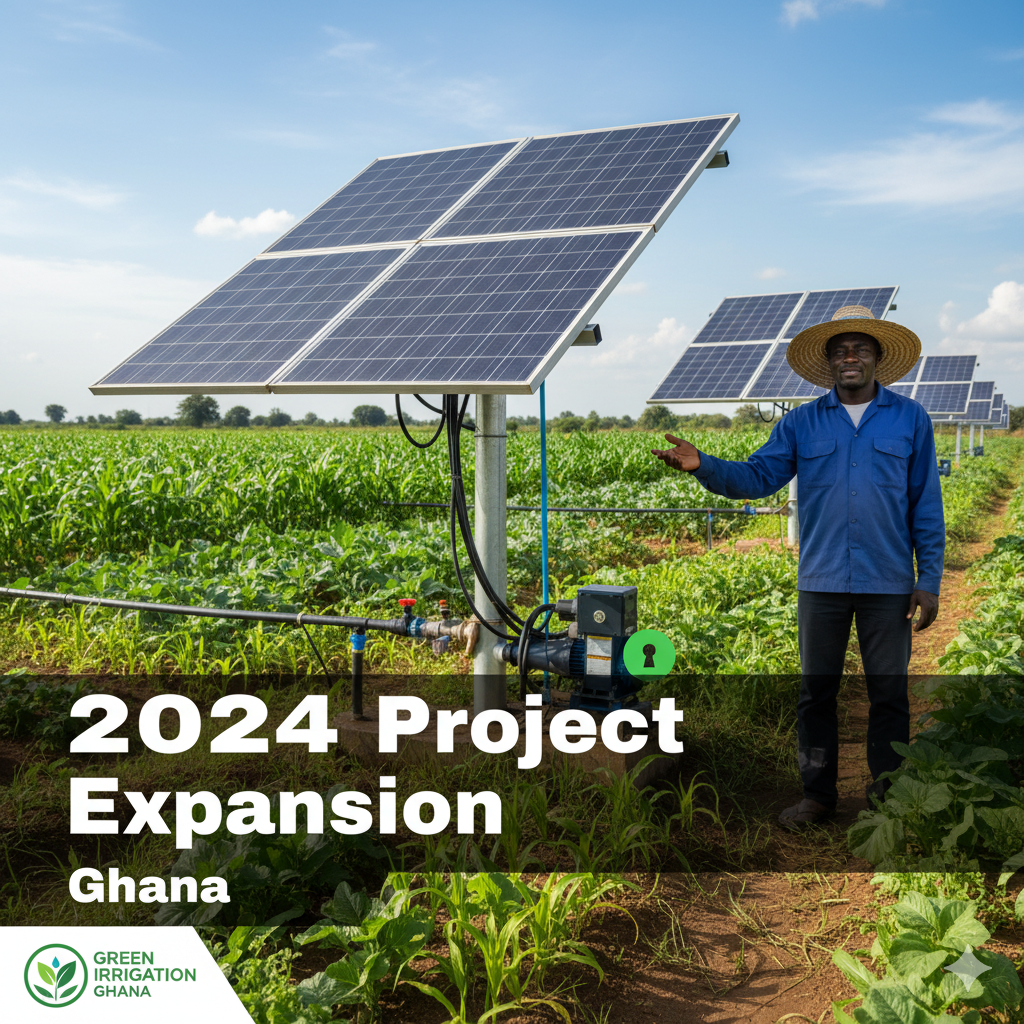
Ghana’s Ministry of Energy has partnered with the Ministry of Food and Agriculture to expand the Water-Energy-Nexus project by adding 10,000 solar-powered irrigation pumps nationwide. This initiative aims to support farmers, especially in rural areas, by providing affordable irrigation solutions to boost agricultural productivity.
10,000 New Solar Irrigation Ghana Pumps
The Ministry of Energy is leading an effort to expand the Water-Energy-Nexus project by installing 10,000 solar-powered irrigation pumps across the country. The Minister of Energy, Dr. Matthew Opoku Prempeh, announced this development during the 2024 Budget Statement and Economic Policy presentation in Parliament. This expansion aims to extend solar irrigation to all irrigation schemes across Ghana.
The initiative is part of a broader collaboration between the Ministry of Energy and the Ministry of Food and Agriculture. Dr. Prempeh noted that the two ministries are working closely to support farmers in rural areas by providing them with solar irrigation systems.
The Water-Energy-Nexus project, which initially focused on providing water supply systems to rural communities, will now also include solar irrigation systems to support agriculture, leveraging the water-energy nexus approach to optimize resource use and support food production.
Dr. Prempeh emphasized the importance of this project in his statement, describing it as a major boost for farmers. “This is a major boost to our farmers, who typically spend a lot of money on irrigation,” he said. This aligns with Ghana’s broader strategy to address food security challenges by harnessing renewable energy technologies.
Addressing Farmers’ Concerns about Solar irrigation Ghana
The expansion of the Water-Energy-Nexus project comes in response to concerns raised by farmers about the cost of water for irrigation. Many farmers have struggled with the high costs of electricity needed to pump water for their crops.
In March 2023, farmers in the Upper East Region asked the government to review the cost of water for irrigation, citing the high costs as a barrier to their productivity. The introduction of solar-powered irrigation systems is expected to significantly reduce these costs, offering a sustainable solution as highlighted in PVKnowhow’s report on solar irrigation benefits for Ghana cocoa farmers.
Dr. Prempeh highlighted the potential benefits of the project, stating, “This intervention will help reduce the cost of irrigation, and we are going to do this for 10,000 farmers in all parts of the country.”
The Minister also mentioned that the solar irrigation systems would be particularly beneficial for farmers in rural areas who have long struggled with the high costs of traditional irrigation methods.
Collaboration with Ministry of Food and Agriculture on Solar Irrigation in Ghana
The partnership between the Ministry of Energy and the Ministry of Food and Agriculture is a key component of the Water-Energy-Nexus project. Both ministries are working together to ensure the successful implementation of the solar irrigation systems.
Dr. Prempeh expressed his gratitude to the Minister of Food and Agriculture, Mr. Brian Acheampong, for his support in the project. “I would like to thank my colleague, Minister of Food and Agriculture, Mr. Brian Acheampong, for his support in this project,” he said.
The collaboration between the two ministries is expected not only to provide farmers with affordable irrigation options but also to contribute to the overall goal of increasing agricultural productivity in Ghana. This collaboration underscores the government’s commitment to Ghana’s solar energy investment as discussed on PVKnowhow.
Future of the Water-Energy-Nexus Project for Solar Irrigation in Ghana
The expansion of the Water-Energy-Nexus project is a significant step towards addressing the challenges faced by farmers in Ghana. By providing solar-powered irrigation systems, the project aims to reduce the cost of water for irrigation and improve the livelihoods of farmers. This is also expected to have a positive impact on food security, aligning with sustainable development goals and climate resilience efforts.
The project is also expected to have a positive impact on food security in Ghana. With more affordable irrigation options, farmers will be able to increase their production and contribute to the country’s food supply.
As the project continues to roll out, it will be closely monitored to ensure its success. The Ministry of Energy and the Ministry of Food and Agriculture will work together to provide ongoing support to farmers and address any challenges that may arise.
The Water-Energy-Nexus project is an example of how innovative solutions can be used to address complex challenges in agriculture. By harnessing the power of solar energy, the project is helping to create a more sustainable and resilient agricultural sector in Ghana. This initiative complements Ghana’s existing renewable energy projects, such as the 50 MW solar plant in the Yendi Municipality and the Ghana floating solar project, demonstrating a comprehensive approach to integrating solar energy into various sectors.


